


Published in 2004, Running Hot was the debut novel by British author Dreda Say Mitchell. Even though it was not conceived as a crime novel, it established Mitchell as a significant voice in contemporary urban crime fiction.
 Lee Child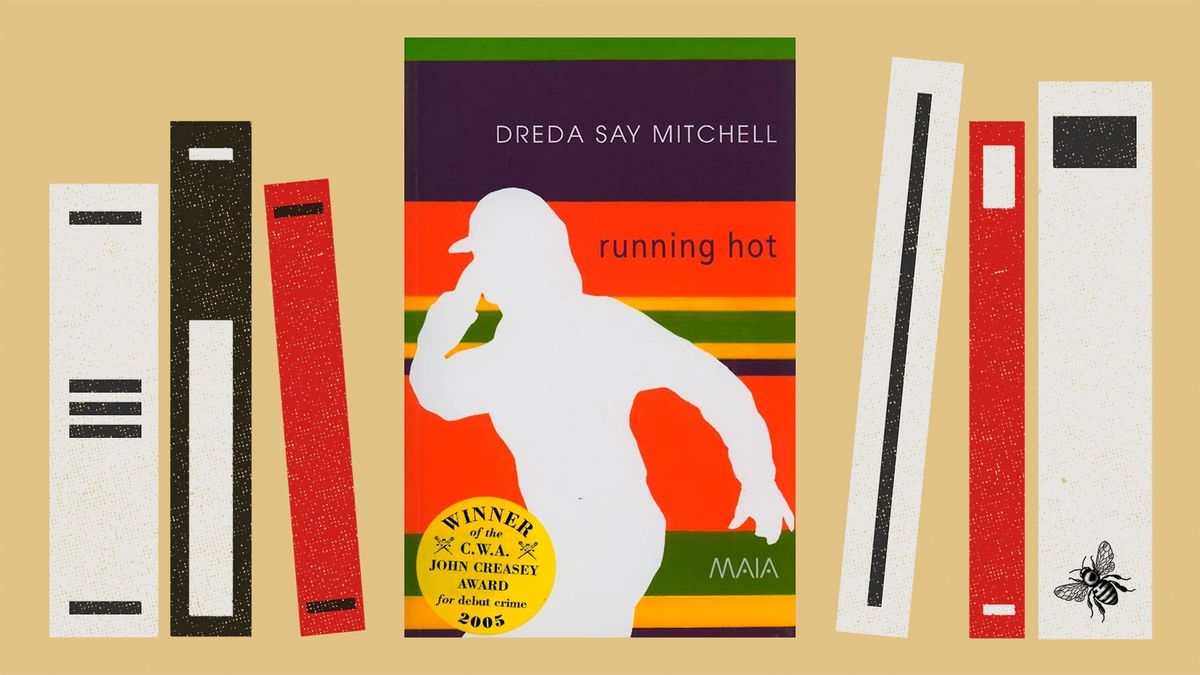
The novel is set in pre-gentrification Hackney, east London. Its story centres on Elijah “Schoolboy” Ray Campbell, a petty criminal and former jailbird desperate to leave his past behind and start a fresh life as a chef in Devon. However, his dreams of escape are derailed when he finds a mobile phone near a dead body in the street. Unbeknownst to Schoolboy, the phone is a highly coveted asset holding explosive secrets. He becomes the target of a high-speed, lethal chase through east London’s underworld, pursued by two ruthless, competing factions: a calculated Nigerian numbers crew and a fierce Grenadian hit squad. The latter is led by a terrifying matriarch known simply as “Queen”, a woman who fiercely upholds family values while coolly dispatching her enemies.
Running Hot received critical acclaim for its pacing and linguistic style, which draws heavily on east London slang. Critics praised Mitchell for updating and adapting the standard gangland thriller format. The Guardian lauded her “slangily poetic zip” and distinct fictional authenticity, while the Mirror remarked that Mitchell “outguns Martina Cole for pure, shocking East End gangster grit.” The Times Educational Supplement praised its “gripping plot, but also its portrayal of east London characters and the gangster underworld.”
There was some criticism, with one early reviewer from the Literary Review commenting that the “ethnic slang” made the “high-speed narrative […] hard to follow”, although he still considered it “well worth seeking out.” Mitchell received many comments from readers, as well as listeners after she spoke about the novel on radio. Some readers and listeners were surprised that someone from Mitchell’s background was writing novels.
Running Hot was inspired by Mitchell’s experiences as a young woman. “Having grown up on an estate and seen some of the most intelligent men I knew end up treading the path of crime”, she wanted to “figure out how I ended up at university and a teacher while many of the young men I grew up with had ended up in prison.” However, she also “wanted the novel to have a certain type of ending because I was tired of reading stories or watching TV where the Black character ends up dead by the end.” But ultimately her goal was simply to tell something of what life was like growing up in working-class east London because “very often I feel that working-class lives are not explored; we don’t really want to talk about them.”
In 2005 the novel was awarded the Crime Writers’ Association (CWA) John Creasey (New Blood) Dagger for best first-time crime novel, making Mitchell the first Black British author to win the prestigious honour.
Dreda Say Mitchell’s biography
Mitchell was born in 1965 and grew up on a council estate in the East End of London in Tower Hamlets. She still lives in the East End with her partner, Tony Mason (also known as Ryan Carter). Mason co-writes with her. He is also from a working-class family and the books they write together are a “fusion” of their experiences.
Mitchell’s family hail from Grenada in the Caribbean and moved to the UK in the 1960s. Mitchell attributes some of her writing style to this heritage, saying: “My family are from Grenada and we are notorious for being nosy! I use the same questions to create complex characters.” She has also discovered that education is very important in Grenada and feels that this led to her parents’ high aspirations for her. Her father left school at 13 to become a fisherman in Grenada before becoming a factory worker in London, while her mother, who also left school before 16, was a cleaner at Mile End hospital.
Apart from the Bible there were no books in Mitchell’s house when she was growing up, but she remembers being regularly sent to the local Whitechapel library to get books with her siblings and neighbours’ kids. However, Whitechapel library no longer exists. Mitchell worries that the publishing industry does not understand this route into reading for certain communities. She stresses that “access to reading can open up a new world for youngsters from economically poor backgrounds.”
Mitchell was the first in her family to attend university (as was Tony Mason) and studied African history at the School of Oriental and African Studies in London (she also has an MA in education studies). She was inspired to study African history after seeing a book in her school library with a Black man (Toussaint Louverture) on the cover. Mitchell worked as a teacher, deputy head, and education consultant across primary and secondary education. Prior to this she worked a range of short-term jobs including waitress, chambermaid, and catering assistant.
Social class in the work of Dreda Say Mitchell
Mitchell found her way into writing when she applied to a prestigious creative writing course at London’s Groucho Club. She was told that “someone like you won’t get it” and “knew they meant because I am Black, working class, and my parents both left school before the age of 15.” This was a friend who was also “working-class like me”, but who didn’t share the “high expectations” of herself which Dreda puts down to her parents’ history of migration. She did get onto the course but found it terrifying due to her background, worrying about being “from a migrant family” as well as growing up on a council estate and her parents’ lack of educational background. Later her first publisher, who also led that course, informed her that “one of the reasons she chose me was because my writing was unique”. Now Mitchell claims both these comments as part of the same pride in her writing and her background, commenting that “‘someone like you’ became my unique selling point. Far from being a weakness, it is one of my greatest strengths.”
She is also positive about the external perception of being working class, arguing that “I think we live in a time when being working class is no longer seen as a negative thing. I grew up on a housing estate in the east end of London and I see this as an incredibly positive aspect of my life”. Similarly she celebrates that “class prejudice is now deemed to be as unacceptable as any other kind.” She claims the East End as “the bedrock” of her writing and has even said that “I think if I hadn’t grown up in east London, I probably wouldn’t have been a writer”. She argues that “The mantra that the only way working-class people are going to be a success is to leave it all behind is not true. Truly successful people are those that are confident and grounded in the people who they are, not what someone else wants them to be.”
She also criticises “people’s depictions of housing estates, all this sense of deprivation, these poor, poor people,” since her experience is that she did have access to things like the local library and art gallery that made her childhood “rich in culture” and “quality of life goes beyond money.”
Mitchell has not always been so sanguine about acceptance of working-class people, however. When Running Hot was published, comments from readers led her to conclude that “We live at a time now where being working class, particularly being white working class, is getting a bit of a hammering to tell you the truth”. She missed the “powerful working-class figures in the art world” that she felt were around in her youth. Nevertheless, she stresses that “those you actually live among” are more likely to be influential mentors than, for example, celebrities who may be helicoptered in by schools for inspirational talks. Her writing is inspired by her father’s oral storytelling, and she emphasises that “Some of the greatest storytellers I’ve known in life are people who left formal education at an early age”.
She does not write “solely” for working-class readers, and points out that the growth of short-term employment, and the contract or “gig” economy is redrawing class lines. “The experience of having [your] backs to the wall financially and being forced to take poorly paid jobs that may not be good for [you]”, she says, is no longer the sole experience of “the poor – increasingly, it’s starting to be the case for people of other backgrounds too.” Her first fan mail, she notes, was from a middle-class white man from Hampstead.
Mitchell uses her platform as a writer to speak out on numerous social and political issues. She has appeared on television shows and has been a columnist for the Guardian, the Independent, and the Observer. Her class background has impacted responses to her television appearances. In 2017 she complained “there has been one constant theme: why do I refuse to speak English properly?” and translates this into “the real question being posed here – why are they bringing working-class types into studios to comment on respectable people’s business?”
“There are still many people in this country who don’t understand that language is a means of communication, not a symbol of social status,” she says, “and that the working class includes some of the most intelligent, articulate and witty people in our society.”
Mitchell felt that it was her responsibility to appear on television panel shows due to a lack of working-class representation. “If not me, who like me? For often, when I’m approached to appear on the media or at public events and have to decline, I am then asked: ‘Do you know any other minority pundits who share your views?’ Or any who are working class, council-housed or comprehensively educated?”
Activism
Mitchell is a campaigner and speaker on social issues and the arts. For example, she is clear that “Writers need to get paid, or we’re in danger of reducing the arts sector to a hobby and lifestyle choice only open to those with the finances to do it.”
She has been a Reading Ambassador for the Reading Agency, and she does work in prisons, helping inmates with reading and writing skills and using “my life as a springboard to talk about the barriers I faced and how I overcame them”.
In 2020, she received an MBE for her services to literature education work. When she was first asked to do this, after speaking at a conference for prison librarians, she felt it “really chimed” with what she had written about in Running Hot. She was commissioned by the Youth Justice Board to pilot a creative writing and mentoring project with young offenders from African and Caribbean working-class backgrounds. Work in prisons inspired some of her later novels, including One False Move, which was written specifically as a Quick Reads novel for the Reading Agency. She speaks of a visit to a women’s prison which “reignited my interest in writing about the working-class people I grew up with, especially the women.”
Running Hot, Dreda Say Mitchell and the Black British crime novel
Alongside her working-class background, Mitchell is concerned with other aspects of her identity. She worries that there are still too few BAME crime writers: “Access has always been a problem for writers of colour and other marginalised groups in society,” she has said. “When we do manage to get our foot in the door there’s still a huge level of pressure on BAME authors to stay in their lane and only write about ‘Black’ issues. […] It’s as if the publishing industry thinks that writers of colour live their whole lives through the colour of their skin.”
Mitchell resists pigeonholing by ethnicity, declining to call herself a “Black writer” because she believes it involves “defining very clearly what you write about.” Mitchell has also suggested that her working-class background exacerbates the racism she faces in the publishing industry since “If you speak the language [i.e. have the right accent], the publishing industry is quite happy to pull you in because you sound like them already. You might be a different colour, but essentially you kind of dress like them.”
The problem, she says, is that in the publishing industry “when they hear Black or ethnic minority, they’re thinking race, oppression, colonial history, migrant. They’re not thinking about a woman who writes about murder and mayhem on the streets of London.”
She argued against Marlon James when he said that Black authors were being pushed into genres that were only relevant to white people, arguing instead that they are excluded from these genres. “It’s when you look at other [not specifically identity-focused] fiction genres that Black authors tend to thin out. I’ve been to events in the crime-writing world where I’ve been the only Black woman among hundreds of attendees.”
Mitchell is also concerned because she feels that being known as a Black writer will mean that people looking for crime writing won’t find her because her books will be stuck in the wrong section of bookshops.
Literary influences
Mitchell has said several times that Alice Walker’s The Color Purple is her greatest literary influence and she argues that it “shows how fiction can be life-changing”. It was particularly important for her because it is about “the triumph of a Black woman from a poor background who overcame the odds stacked against her”, which was a “powerful message and motivator” for a young Black woman growing up on a council estate.
Mitchell has said that Lady Macbeth is her favourite fictional character, despite struggling with Shakespeare at school. She criticises her school curriculum, which contained “no books by any Black authors”, driving her to read only Black female writers during her twenties.
As a young person she loved the Poldark novels by Winston Graham, citing class as a key theme that drew her to them. Lee Child is a strong influence, particularly Killing Floor in his Jack Reacher series. Mitchell praises the crime-writing community as being extremely welcoming and supportive to her throughout her career, and she singles out Child as a successful author who took notice of her after the publication of Running Hot. They met at her first crime fiction convention, when he helped her find her way to a venue and then chatted with her at lunch. He has continued to be what she calls her “biggest supporter”.
Crime writing and class
Mitchell considers that the crime-writing community is so welcoming because “for a long time, they were kind of dissed and put down by the literary community as not proper fiction”, which meant that they bonded as writers and are keen to welcome new blood “because it’s such a popular genre, there’s room enough for everyone.”
Running Hot fits into the genre urban crime fiction, although Mitchell did not write it intentionally in this genre (“I thought I was writing a redemption piece,”) until her publishers “gave it to a crime novelist, who said it was a crime novel.” Mitchell has said she realised that if she described the novel through its plot and as a crime novel it generated much more interest than describing it as being about redemption. This points to another reason why Mitchell resists being pigeonholed as a Black novelist who will be expected to write about “heavy” subjects like identity and racism.
The critic Gill Plain describes urban crime fiction as centred around “the city as a site of conflict between competing cultures of power” as well as “a space for the negotiation of gender anxieties”. The genre often focuses on the city to the extent that location becomes a “character” in its own right, and Mitchell acknowledges that “inner London is as central to her novels as some of the characters”. Crime fiction has had a long-standing, if sometimes problematic, relationship with the working class, and Plain describes the role of police officers who maintain order “through the more-or-less heroic agency of white, working-class masculinity.” It has also been seen as a key site in literature for Marxist interpretations: according to Andrew Pepper, author of the 2020 book Crime Fiction and Global Capital, “what distinguishes crime fiction’s treatment and interrogation of capital is its insistence upon drawing out the violence which is often hidden by and in other types of fiction and modes of representation.”
However, Pepper also demonstrates that there is ambiguity in how crime fiction approaches social issues since although fiction about crime tends to “draw attention to the failures, flaws, and coercive capacities of the state’s crime and control mechanisms,” what could be interpreted as “overt political radicalism is contained by the accommodations crime stories must make towards the articulation of law and the restitution of order” as it often seeks a solution that restores social cohesion.
Although these reasons seem to make working-class representation a logical move in crime fiction, it has not always been associated with portrayals of working-class individuals. Although British Golden Age crime fiction was often set in rural communities, Snell demonstrates that lower-class characters are “rarely developed”, not even as murderers, although Dorothy Sayers’ novels are an exception.
Mitchell has explored some of the drawbacks to crime fiction, in that it can be extremely triggering to people who have suffered criminal acts, or fear them, including rape and violent abuse. However, she suggests that the fact that crime touches people personally also makes them want to read about it and see it represented in fiction.
Crime fiction is not entirely welcoming to Black writers. Peter Messent, author of The Crime Fiction Handbook, highlights that “Blackness – almost inevitably – comes accordingly to stand in contrast: for criminality, ‘otherness,’ and an unfamiliar, unknown, and threatening social world”, creating a problem for Black crime writers who try to fit in with the conventions of crime fiction, which are “geared toward the interests of the dominant white world”.
However, crime fiction is particularly growing amongst francophone African authors and research in this area suggests some reasons why it might be attractive to Black authors. The critic Pim Higginson highlights “its exploration of what one might call a poetics of the vernacular. Racial, ethnic, class, gender, and regional origin are all increasingly reflected in the speech of the characters that populate the works of the hard-boiled school.” Christian Patterson argues that Running Hot “offers a cacophony of voices across the classes”, tapping into this tradition. Another review by Higginson praises dialect spellings in Running Hot for making the novel “more urban and gritty”. This is an additional attraction to the genre’s interest in exploring “the policing of social boundaries” as discussed by Higginson above.
In addition, Robinson points out that the hard-boiled tradition in the US was “fundamentally entwined with the possibility of interracial sociability”, with plots relating to issues such as the social impact of emancipation and resultant changes in labour divisions, which, even if racist in their initial appearances, opened up spaces for later writers to appropriate the genre to challenge racism in society. Finally, Martin suggests that noir or crime thrillers, which focus on the criminal rather than the detective, grew out of racialised discourse around crime in the mid-20th century in the US, meaning that they arose through Black authors like Richard Wright and Ralph Ellison challenging the white establishment. Running Hot is not focused on a detective, but Schoolboy is closer to someone solving a puzzle than committing a crime, meaning this novel fits somewhere between the two categories of this genre.
Literary influences
Martina Cole was “the first writer I knew who had the brass to write stories about the struggles and experiences of women who lived on council estates. She made me realise that someone with an accent like mine has a right to be heard just like anyone else in our society.”
She suggests that Martina Cole’s novels are very popular with working-class women “because they resonate so much with their own experience.” Cole was also supportive when Mitchell was a new writer, offering to spend a day with her when Mitchell called to ask for a quote for her gangland novels.
Chester Himes, the African American crime writer, is another significant influence. Mitchell remembers coming across his novels in the library as a child and being “transported back to an age when Harlem was hip, cool and, of course, dangerous”. Himes has been particularly influential on the francophone African boom in crime fiction in the 21st century, largely because his crime novels were initially published in French while he was living in Paris.
Agatha Christie is another key influence, as she is for any British crime writer, and Mitchell “admires Christie’s determination to give older single women a voice”.
The publication of Running Hot
Running Hot was published by a small independent publisher, Maia Press, which Mitchell describes as “two ground-breaking women who set up their own publishing venture from a house in Hackney.” One of these women, Maggie Hamand, ran the course she attended at the Groucho Club, where she developed the character of Schoolboy. Hamand asked Mitchell if she could publish a chapter of Schoolboy’s story in an anthology, but then asked if she could actually publish the whole book. This came as quite a shock to Mitchell, who did not have the whole book ready. She rushed home to her partner, Tony Mason, who now formally co-writes with her under the pen name Ryan Carter, and they hashed out the rest of the plot together in cafes. Mitchell recalls “writing the book on the Tube” to get it done.
A crime writer known to Mitchell’s publisher encouraged them to put Running Hot forward for the John Creasey Dagger; when Mitchell won, she says it was the proudest moment of her career.
Since her fifth novel, Mitchell has formally co-written with her partner, Tony Mason, although he is only credited (as Ryan Carter) on some of the book covers. She values writing in partnership as an “easier process” which allows the two writers to bounce ideas off each other and use their own strengths. Mitchell claims that Mason’s strength is in plotting while she is good at adding emotion and also takes on most of the editing to ensure a consistent style (his writing is “Dreded up” through her edits).
The team are prolific and Mitchell claims they write each book in about six weeks. They are published by Thomas & Mercer Amazon, but only have a contract for one book a year, which is not enough for their output, so they also self-publish. Mitchell and Mason turned to self-publishing after realising that their advances from their mainstream publisher started dropping after the first few books. “What job,” Mitchell asks, “would you be in where you would, after a couple of years, expect to get a pay cut, and then a pay cut, and then a pay cut?”
She left the mainstream publisher, took some advice from very willing members of the crime-fiction community, and is now positive about self-publishing: indeed she sees her adoption of it as being “when our big success started”. (So far Mitchell’s books have been translated into 14 languages, and there are rumours that some of her recent books may be adapted for TV or film.)
She also suggests that the move to self-publishing means that “artists creatives writers are starting to see that they’re the ones with the power.”
Mitchell puts some of her dissatisfaction with the remuneration system in traditional publishing down to being working class, emphasising that writing is “work” and so writers should be fairly paid like other workers, and associating this belief with a “work ethic from my parents and from being working class”. She also credits this work ethic with her ability to meet deadlines and make it as a writer.
Some of Mitchell’s later novels centre around gang violence and the characters “represent the many strong women who lived on my block as a child.” In later life, she realised that many of these stories were influenced by her mother’s early death when she was 28 and involve young women looking for mother figures. This led to a realisation, which she had been denying for years, that she does write about her own life in her novels.
Mitchell continues to often write about London and claims that it is important to have a “range of characters” in her novels because “you can’t write about our great capital city if you don’t truly reflect the different type of people who live there.”
All donations go towards supporting the Bee’s mission to nurture, publish promote and pay for the best new working-class writing.




Comments