


Whenever I tell someone from Middlesbrough that I grew up in Acklam, I can guarantee that they’ll call me ‘posh’. With its curves of privately owned homes and a beck that winds its gentle way through meadows, Acklam’s one of the last Middlesbrough suburbs to come to mind with regards to child poverty. Yet halfway down one of its few 1970s-built terraces, I grew up in a family who received Income Support, a form of benefit once given to the poorest people.
In those late-1990s days, welfare payments had to be redeemed at the Post Office, so every school-holiday Tuesday would see me queuing alongside my mam and dad. With my hands nestled snug in theirs, I’d stare at the shelves full of teddy bears they told stories about, to take my mind off the dirty looks our neighbours gave us. Yet my parents couldn’t protect me from the slaps or stamps or strangles that came my way in the playground. Nor, apparently, could the teacher who eyed the swelling round my temple and said, ‘Don’t you dare tell me that! Catherine isn’t a bully: her daddy works!’
So alongside maths and science, I had to learn an extra lesson: as the child of a benefits family, I would not be heard or believed. Ever the diligent student, I stopped telling the teacher about the cause of new wounds, until the bullying grew so bad that my parents insisted I was to have my dinner at home. Those hour-long respites from the torment of the playground gave me the strength I needed to get through the rest of the school day, but they came at the cost of further mutterings. ‘My mammy says only riff-raff have that much time on their hands,’ and ‘that fella should be at work.’ Words that cut my heart and crushed my stomach, till red sauce sandwiches were all that it could manage. Till I came down with infection after infection, and never played outside – and I might have shrunk to nothing if it hadn’t been for Craig Noe.
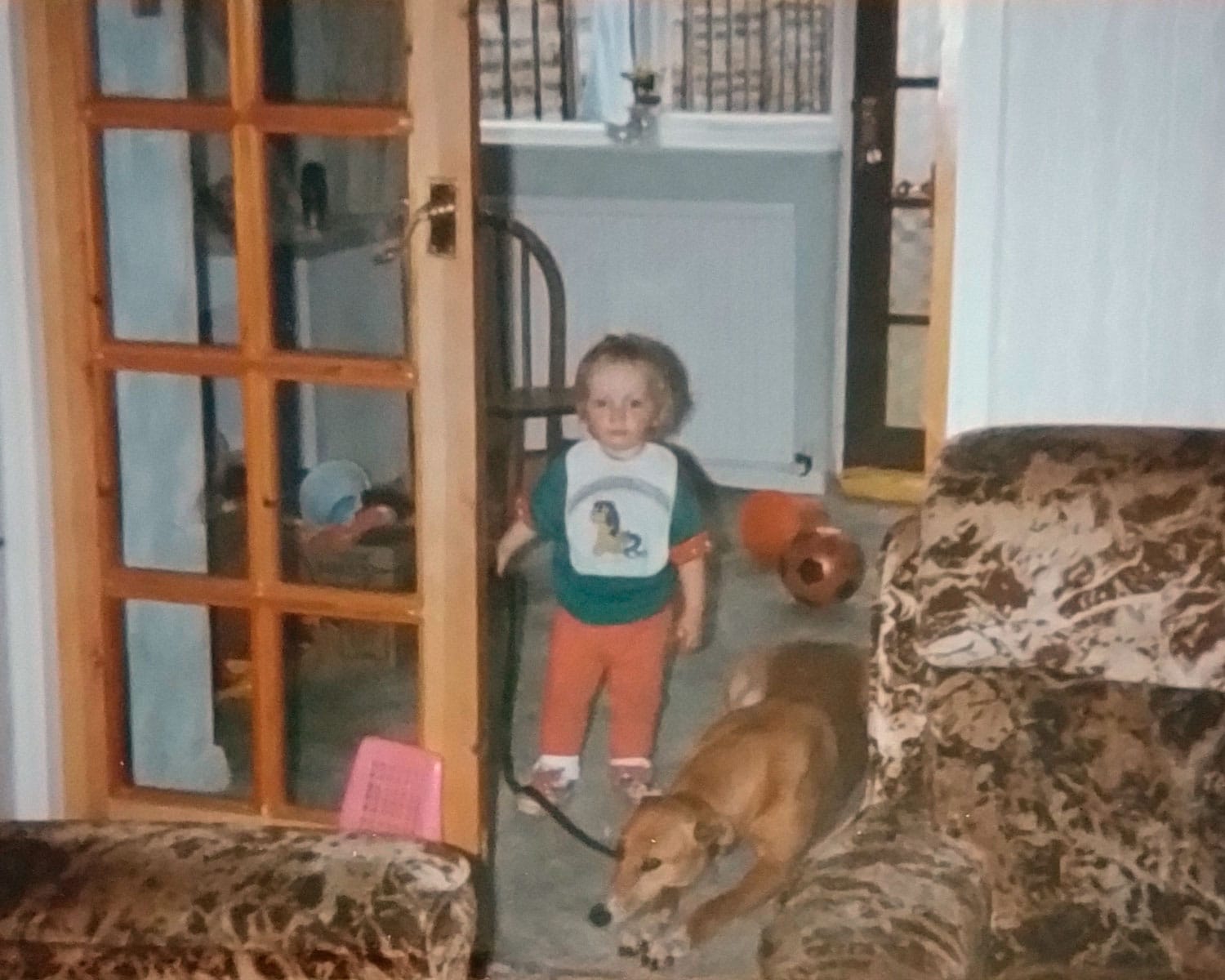
A strapping brindle greyhound, he was: all bronze muscles, jasper stripes and oaken eyes. Irish-bred from an eminent sire and dam, Craig Noe had come across the sea to race for my much older middle brother. Not at Newcastle’s dog track, which operated under the strict rules of the National Greyhound Racing Club, but on County Durham’s independent circuit. Commonly referred to as ‘flapping tracks’, the likes of Wheatley Hill and Easington let anyone from anywhere race a greyhound round their sandy ovals.
I’d been part of the flapping community since I was a newborn, when my eldest brother’s fawn bitch Fly raced as Clwyd Lodge. The whole family would pack into an auld banger to cheer her on at the track, but later years saw us lavish her with treats, while she lived out her retirement as our beloved pet. So when Craig Noe came along, it was a few years since we’d been to Easington Greyhound Stadium, and its unfamiliar vastness meant I hurried to my mam. Wrapped my arms round her neck as she clicked us through the turnstile; hid my face in her jacket when the café door squeaked open. Pretended that the fag smoke and fried onions made my throat tighten, while the hubbub become a quiet that amplified every palpitation.
‘Lang time nee see, Benny!’ came a fella’s shout, while a group of women asked, ‘How ya deein’, Annie pet?’ And the knot in my belly loosened as those voices steered us to green plastic chairs; cooed what a dot of a bairn I was. Promised their kids would keep an eye on me if I ever wanted to play, and I looked up from my mam’s chest to find freckly faces nodding. Swearing on Tamagotchis that I’d be alright, till my cracked, chapped lips remembered how to smile.
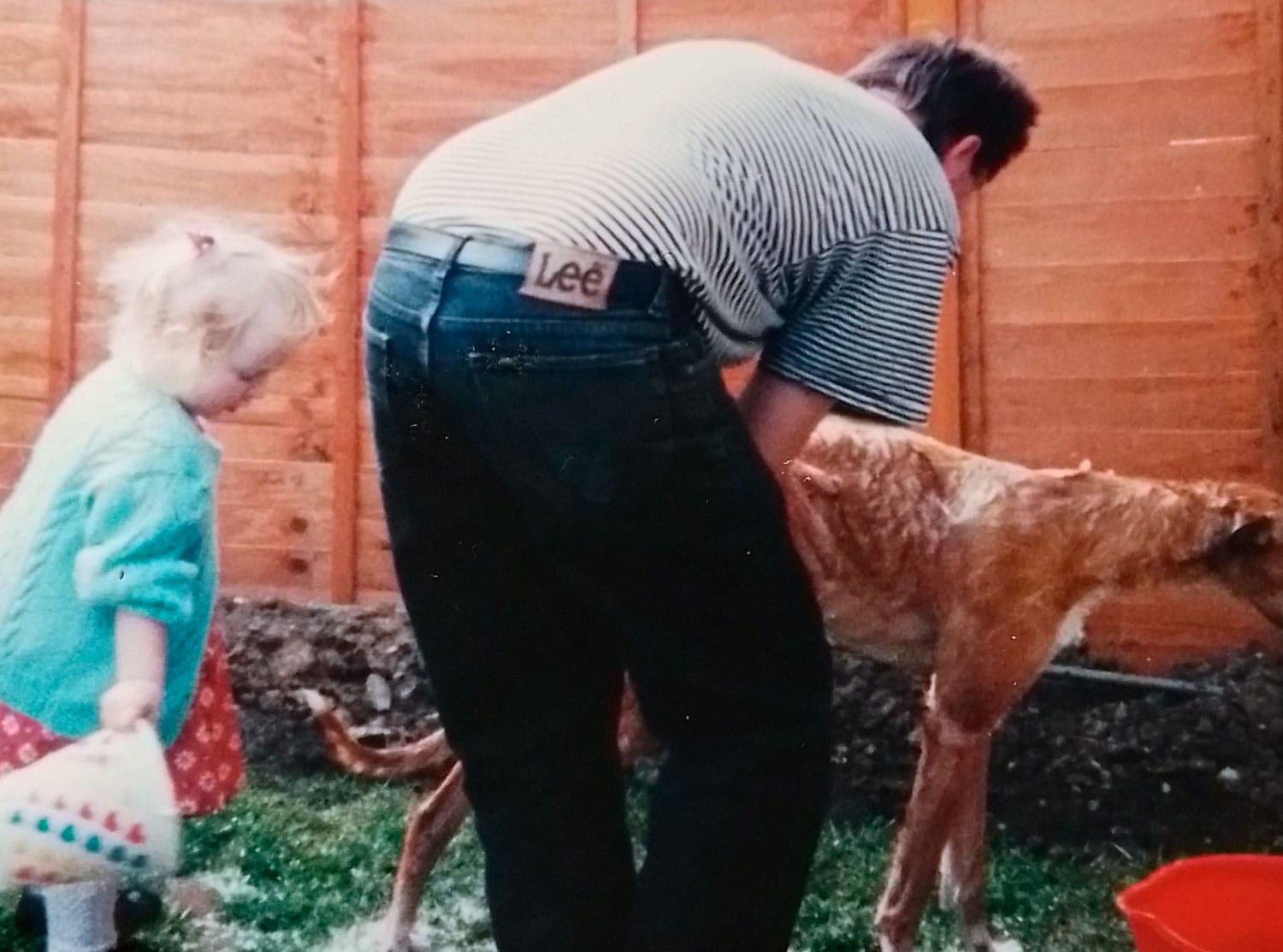
After a few meetings, I was playing hide and seek, and sharing vinegary chips and bags of 10p mix-ups. Strutting beside my dad and Craig Noe in the pre-race parade, I waved first at my mam, then at my new friends: brown-haired Laura in the pink duffle she’d put round me when I shivered, and Danny with his blond spikes. He called himself my bodyguard, but said the lads at Easington were far nicer than the ones who went to his school. ‘It’s the same with the lasses,’ Laura sighed as she zipped me into her coat; and I found myself telling them about my bullying. Then freezing, as they gave me this deep, hard look – but then they said as one, ‘That’s terrible.’
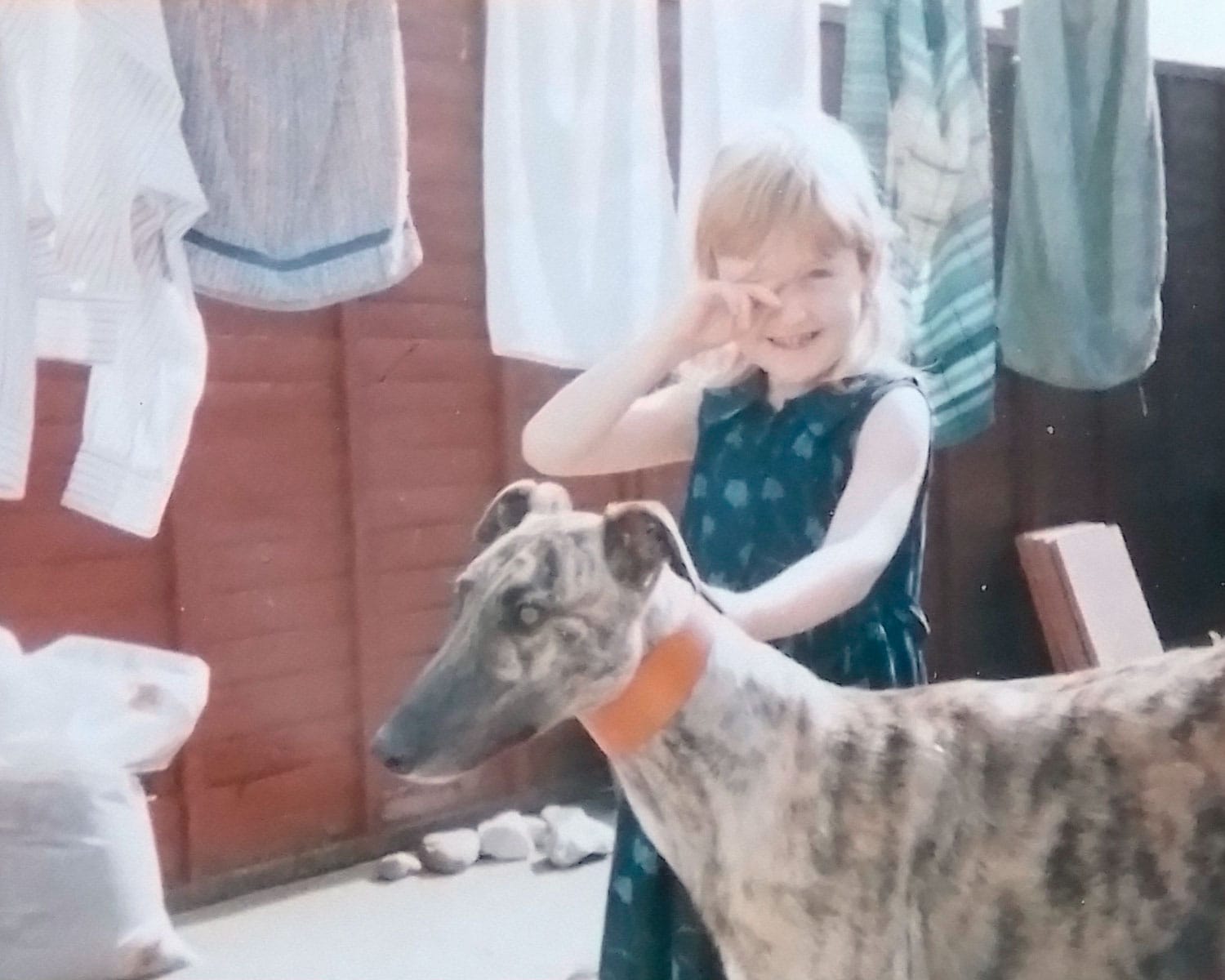
And when the warmth coursed through me, I knew it came from more than Laura’s duffle; that the sun shone hot inside my veins because I’d found a place where I belonged. It was a precious feeling for a six-year-old lass, one that strengthened with every trip that my family took to Easington. Once Craig Noe had retired to my middle brother’s home, my auntie gave me a coal-coloured bitch called Molly. Between the responsibility of getting Molly ready to race, my trackside games with Danny and Laura, and the continued support of my parents, I found ways to cope with the bullying. While I was still too young to understand that it was rooted in class, I sensed that there were bigger factors driving the behaviour I encountered.
That instinct sustained me throughout my teenage years, when a now-retired Molly curled up in the porch and I began to write. There was a short story inspired by the turnstile man at Thirsk Races, who used to bend the rules so that he could let my whole family in for just two quid a meeting. I penned an article which railed against the ‘benefits scrounger’ stereotype, then made a piece of performance poetry that exposed the callousness at the heart of David Cameron’s austerity measures. It was a cruelty that I understood first-hand, as I also had to use my writing to challenge benefits decisions that made my dad suicidal. ‘The letter Miss Powell wrote is so powerful that I have no need to hold this tribunal,’ the Judge said. ‘I overturn the decision and will not hear a single word of complaint.’
At the same time my words won battles against the DWP, emails arrived to tell me I’d been shortlisted for national writing initiatives. Yet as none of them explained that writing could be more than a hobby, I was in my late 20s before I started taking my craft seriously. I attended an introduction to screenwriting course run by New Writing North, which taught me it was possible to pitch for opportunities. I was working three part-time jobs alongside a funded PhD and being an unpaid carer for my parents, but I burnt the candle at all ends to write. A pitch for a play about a man shattered by the benefits system, then tales of a world fast slipping away. Easington Greyhound Stadium had closed to become a new-build estate, and only four flapping tracks remained in the whole of Great Britain. While I couldn’t do a thing to stop the closure of the tracks, I knew that their colourful characters and high-stakes gambles had the sort of storytelling potential that would allow flapping to live on in another form. A fitting way, I thought, of giving back to the world that had given me so much.
What began as an essay published in Kit de Waal’s Common People anthology mushroomed into a body of work. I was commissioned by Durham Book Festival and Hartlepool Little Waterfronts Festival to write short art films and a spoken-word piece which explored the heritage of flapping, then had an audio drama broadcast on BBC Radio 4 Extra. Yet as the praise and credits grew, I began to receive the messages. ‘Benefits scum writing about benefits scum’ and ‘you must have made up your doctorate cos educated people don’t write about trash’. When my pilot social history podcast attracted so many listeners and so much media attention that National Lottery Project Grant funding followed for an eight episode series, my inbox pinged with a fresh load of bile. ‘I’ve put in a complaint to the Arts Council!’ one person told me. They swore that they’d get my funding stopped, so I couldn’t waste taxpayers’ money on something that only ‘riff-raff’ did. Not content with threatening my livelihood, the trolls went on to write lurid descriptions of exactly how they’d put ‘you greyhound scum’ to death.
My chest tightened and prickled and burned; my stomach lurched and my shoulders sank. I sagged shivering behind my laptop screen, fighting nausea and the urge to curl up in a ball. For all I knew, they might have my address; they definitely had the dates and venues of events that were open to the public. I’d been the victim of assault and sustained harassment just a few years before, so the messages brought that trauma back, compounding the hypervigilance that every female has to practise. Without the reassuring presence of my family at all public-facing events and the Arts Council’s willingness to ignore the complaints, I might never have made the podcast series that won praise for enabling my community to tell their stories in their own voices.
It was a long time before the shock of the online abuse subsided, and I felt able to consider the people behind the threats. Young lasses with bios that advocated for inclusivity; older men who mocked the way that women dressed for Aintree’s Ladies’ Day. People who said ‘I like the finer things in life’ and ‘we should all #BeKind’, and scores of anonymised accounts that screamed for an end to greyhound racing. I’d never stayed on any profile for longer than it took to click ‘block’, but it was time enough to clock the hypocrisy and classism of the trolls. And once time gave me a little more distance, I realised that little had changed from my primary school days. There was the same conflation of worklessness and immorality; the same refusal to see the value of unemployed lives. The same desire to silence my speaking of my truth, even if that meant I came to physical and mental harm.
It was only when I started speaking to other creatives within the greyhound community that I realised how pervasive this attitude is. Paul Wilson grew up on a South Yorkshire council estate, where he developed a lifelong passion for whippets and greyhounds. After racing on flapping tracks, Paul now has runners on the licensed circuit, and writes poetry that he circulates to a handful of folk. ‘I know that if I share it [more broadly, middle-class] people would look down on it as something from the lower classes,’ he remarks. Having been targeted by online trolls for his involvement in greyhound racing, Paul believes that ‘we mean nothing to these people.’
Paul’s granddaughter Grace Cawthorn has inherited both his talent with words and his love of the dogs. At the age of just 15, Grace won the BBC Young Reporters (North) 2023 competition with an essay about the life-changing influence of the greyhound community. ‘I’ve always been really nervous,’ she explained, ‘but being at the track and talking to new and like-minded people really helped.’
Yet as Grace worked with the BBC to make a short film about her experience, she had to think about more than her script. ‘There was a bit of concern about the anti-racing people,’ she remembers, ‘and when the film was shown on TV, I did get a few threats from them – and a ‘rescue’ charity!’
When Paul’s and Grace’s experiences are set alongside mine, they point to a multi-faceted middle-class drive to silence working-class writers. From the slurs we hear in our childhoods to fantasies of fatal injury to our adult bodies, we are constantly under not just criticism, but threat. Every word that we write is an act of defiance, one which consumes huge reserves of energy. Even when we have a final draft, our battle isn’t through: we must mentally prepare to mute and block and report. To look out at an audience and convince ourselves we’re safe; to slump exhausted afterwards from the strain of it all.
It’s a process at the forefront of my mind, as my debut novel Underdogs nears its publication date. With the novel set in the flapping world, and launching at Newcastle Greyhound Stadium, I’ve had to have frank conversations about possible backlash. I know that these aren’t the sort of discussions that a debut author should be having, and I’ve grappled with the guilt of potentially exposing John Murray Press and New Writing North to vitriol. Yet I also know that both organisations share my attitude: as awful as it is to be on the end of threats, it would be far worse to let the bullies win.
So as time speeds towards July, I remind myself that I’ve written a novel which needs to be heard – for the sake of my family, my community, and every other working-class writer ever ordered to shut up.




Comments