


I started writing because I was angry. When I was reading to my young children I couldn’t find any books where people lived in a block of flats like we did. So I wrote about it. I wrote about why it was important to show housing diversity and socio-economic diversity more broadly. Then I compiled a list of children’s books which feature families living in flats, and where said flat is not central to the plot as a marker for urban deprivation or poverty. The article was published and I felt better.
Parents and educators messaged me. “I’ve never thought about this before”, they said. I know you haven’t, I thought but I didn’t say that, because I was happy that they were thinking about it now, and thankful that they took the time to tell me so.
I got angry again when I read Roald Dahl’s Matilda to my kids and noticed it was chock-a-block with classist tropes that I hadn’t picked up on when I was a child. Matilda’s parents love TV, hate books, and despise their intelligent daughter. Dad is a petty criminal and Mum doesn’t work or cook. Dad wears a tacky suit and gaudy tie. Mum is a “large platinum blonde woman” with “mousy-brown roots”, and heavy make-up. Look at their poor taste! What terrible parents! See how stupid they are! I wrote it down again, digitally scribbling some words on my phone one evening when the children were in bed.
During Covid I got angry again. This “we’re all in the same boat” nonsense was everywhere. Not just from mainstream media, but from my community and friends too. Class inequality was staring me in the face more acutely than in my living memory, which is saying something considering I was born when Thatcher was in power. But no one around me was talking about it. I didn’t know how to say it out loud without screaming or ranting. So I wrote it down. I wrote about our allocated daily exercise in a gentrifying corner of south London. Looking out from the top of the park onto the city skyline, I imagined the tall shiny, silver offices devoid of bankers — replaced by a smattering of cleaners, security guards and baristas. London’s lowest earners, keeping the capital going.
That piece won me a place on the ‘A Writing Chance’ a development programme for working-class writers, supported by New Writing North and Michael Sheen. The people behind it saw that the barriers to a career in the arts were getting taller, wider, firmer. The infrastructure that, a generation ago, had enabled access and opportunities to some working-class artists simply didn’t exist anymore. I felt happy again that my story had resonated with people. Michael Sheen — yes that Michael Sheen — told a national newspaper that it made him think about what it was like to navigate the pandemic with young children, no money, and no outdoor space. In doing so he was considering the experiences of millions of other people in a similar position. This opportunity, brought about by my silent rage, changed my life. It was the first time I’d ever thought of myself as a “writer”.
The truth is, I’m not an angry person. I can find joy in everyday places. Examples fresh from today include: a phone call with my twin sister, singing Motown songs with my kids in the car, and watching a parakeet eat pink tree blossom from my bedroom window. And yes, writing too can bring me joy.
But I don’t feel compelled to write about any of that. Of course, working-class writers don’t just write about being working class — that’s reductive, one-dimensional, and frankly a bit boring. But, the truth is, I write best when I’m fired up about something — something that’s made me so angry or sad I can’t quite say it out loud. My words fall over in my mouth, I um and ah and sound hesitant when I’m anything but, and often tears come out when words don’t. So I write it down instead. This brings to mind my working-class upbringing — with an emphasis on the “my” as they’re not all the same. Particularly as a girl-then-woman: a product of a society where appearance is everything. Endure but for God’s sake just get on with it. I’m thinking here of what is not said. Don’t grass, don’t complain, don’t answer back, don’t ask why. Don’t show off (if you’re clever), don’t show me up (if you’re not). Bear other people’s anger but never unleash your own. It’s a silencing that’s implicitly enforced. Our voices aren’t to be heard. Literally — I softened my accent a long time ago without even realising. I now sound a bit like my mum’s ’90s telephone voice, the one she used when she answered the landline by reciting our home phone number. But what I can do is write down the words I can’t say, the complaints I can’t make, the screams I can’t scream.
My dad wasn’t good at expressing his anger out loud either. Not with words, anyway. A few years ago I found the start of a novel he’d written while in prison in the 1970s. It’s spread throughout seven prison-issued exercise books, variations of faded beige and drab orange, with ‘GENERAL EDUCATIONAL NOTE BOOK’ printed on the front. Inside the front cover of ‘Volume I’ is a pull-out flap listing “Instructions for Prisoner’s Note Books” [sic].
“You may if you wish take this book out with you when you are discharged provided you have not written in it about any of the following matters:
Your own life
Conditions in the prison
The lives of other inmates or ex-inmates”
Imagine being forbidden to write about your own life. That’s taking deprivation of liberty a bit far.
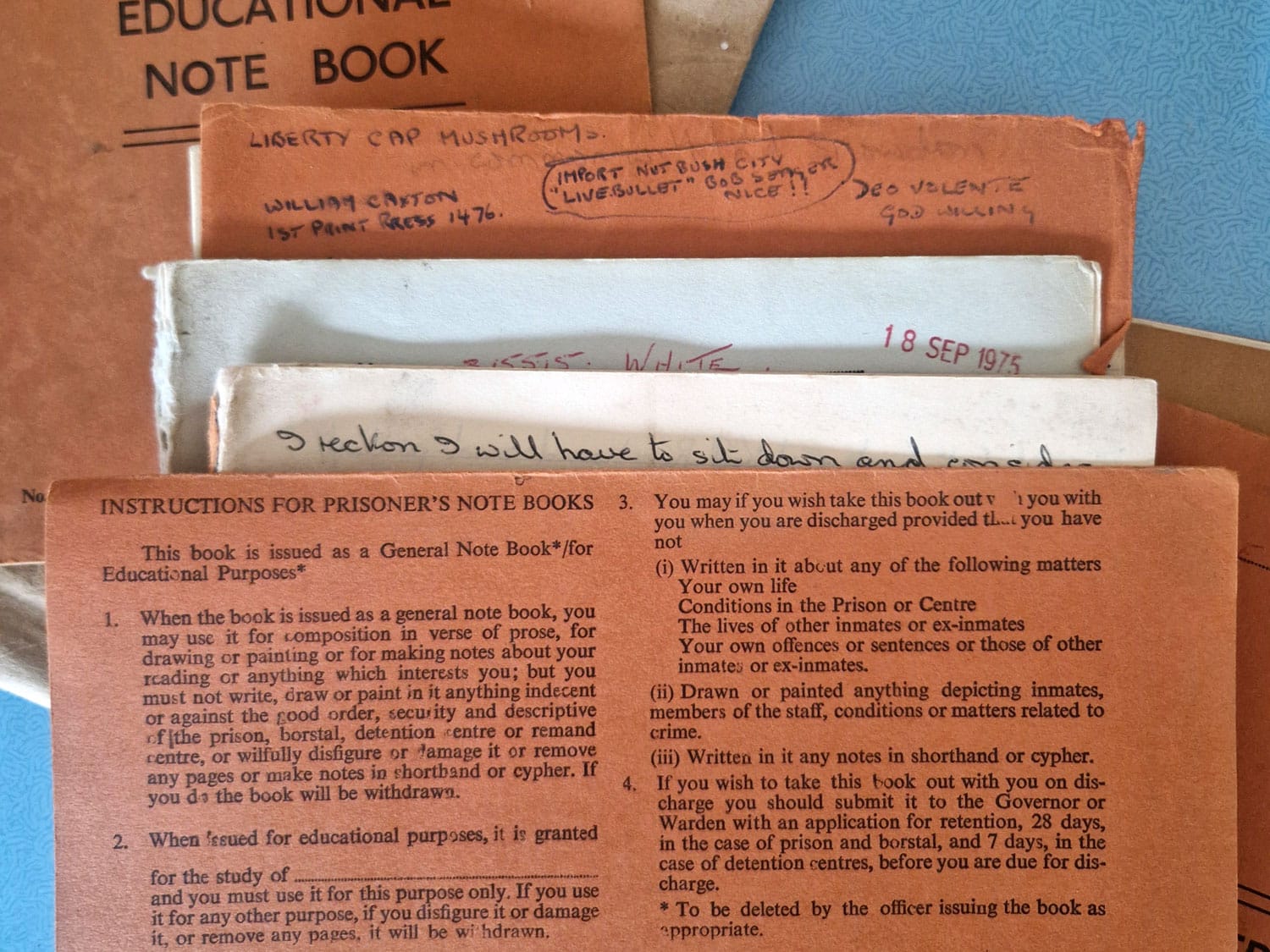
The novel opens on an auspicious day. The protagonist is being released from prison and sets off to start a new life on the straight and narrow. My dad gets around these rules by changing the protagonist’s name and some identifying details, although it’s clear to me that the book is based on himself. These days they’d call it autofiction.
Just as I do, he’s marked the sentences he needs to return to in a later edit. I scan the text for matching asterisks to find his prompts and additions. Most are scribbled in the margins,
a place he was all too familiar with.
“*more description of the room here”
“*include examples of book titles?”
“*add details of place in first para.”
At points, I can see he’s changed a single word three or four times, only to settle on the original one. These are the indelible markings of decisions being made at a time when he had very little scope to make any decisions at all. In writing, he got to make choices. He had the freedom to rescind those choices and make different ones. Maybe creatively engaging with his past, present and future moved him towards some kind of transformation. Gloria Anzaldúa was right, writing about your life can provide a handle with which to grasp it better. Or maybe it just made the days easier to get through.
As a child, I knew he liked to write but not for a moment did I consider him a writer. The likes of us didn’t become writers. I’d carried certain assumptions about who could call themselves that. Unspoken assumptions, as so many societal norms are. For me, a writer was more than someone who writes. They don’t write any old thing for a start, they write newspaper articles or books that get published. They’re at ease mingling with the literati. They know what “literati” means. A proper writer is sure to have a study in their house with a writing desk. No additional day job probably, since writing is the day job. Even those that aren’t well-off financially are well-educated and well-connected. Those who didn’t finish school, or who have never considered publication to be a possibility? Those who have never met a jobbing writer in real life so instead hold folkloric ideas about what that look like? How many of these writers find their readers? And why does it even matter anyway? Of course, it all starts with a book by somebody else. I can picture the intricate shelving my dad had built in the hallway of our council house. On opening the front door, you’d be faced with a mini-library of ‘classic’ fiction and poetry, illuminated from below by tiny spotlights. People are surprised when I tell them that. We have the same kind of received ideas about who reads as we do about who writes. Those ideas don’t tend to include, for example, builders arrested for breaking and entering.
Literature has always been a site of power, even if the writers themselves are underrepresented or oppressed. We just need the gatekeepers to step aside so that the necessary pathways and platforms exist. In this way, those writing in and from the margins can wield influence. In a time when “class consciousness” is found predominantly in textbooks, some people don’t realise they need voices that reflect their own experiences until they find them.
And that really does matter. It matters because otherwise there’ll be a dearth of books set in the UK that accurately depict how a significant chunk of the population lives. There’ll be children’s books written by established authors or celebrities that misrepresent or mock working-class people, or just ignore their existence altogether. People will keep assuming that all incarcerated people have no interest, or potential, in anything that could be described as ‘literary’. It matters because, despite more recent initiatives for underrepresented writers, things are getting worse for artists from lower socio-economic backgrounds, not better. Fewer people are reading and writing for pleasure than ever before, when it can literally improve your life. It matters because there are headlines in national newspapers like “Working-class creatives don’t stand a chance in the UK today”. Because the logic that the most talented people with the most brilliant minds also happen to come from the most affluent backgrounds just doesn’t add up. I’m sure I’ll write about joy one day. Perhaps during a writing ‘retreat’ that I don’t feel out of place in, after I’ve spoken to an agent who wouldn’t dream of saying “but I’ve already got a working-class writer on my books”. Or – the holy grail – after I get that publishing deal that means I can write for a living without the need for a financial safety net that so many of us don’t have.
My dad’s story ends mid-sentence (that’s where he was too). The last volume must have got wet at some point. The blue biro ink has bled into the final pages, just like the tattoos on his arms. I’ll never know the fate of the remaining notebooks, or whether I’m the only person to have read them other than him — save for a skim read by a prison official or two. Maybe the act of writing was enough. A statement of intent. A defiance of the rules, written and unwritten, which dictate who can write about their own life, and who can’t. It’s not enough for me though. This essay was written to be read — and not only for my children to discover when they’re older. They already know that working-class people can read books and that they can write them too. Whether those books end up being published, that’s another story altogether.
This essay is taken from Bread Alone: What Happens When We Run Out of Working-Class Writers, a collection of essays by Kate Pasola and published by Indie Novella. Click here to buy this book from our bookshop – and we heartily recommend it.
All donations go towards supporting the Bee’s mission to nurture, publish promote and pay for the best new working-class writing.




Comments