


David Storey’s early life, Rugby League and British literature
David Storey was born on 13 July 1933 in Wakefield, the son of coalminer Frank and Lily (née Cartwright). His older brother Neville died while Lily was pregnant with David, creating an environment of grief and loss which characterised his early years. Of his childhood, Storey remembered the housing estate in which the family lived as nestled between two collieries, a mill, brickworks, and the Pennines. Storey won a scholarship to the Queen Elizabeth Grammar School and, at 18, signed a fifteen-year contract with Leeds Rugby League Football Club (now Leeds Rhinos).
 Richard Benson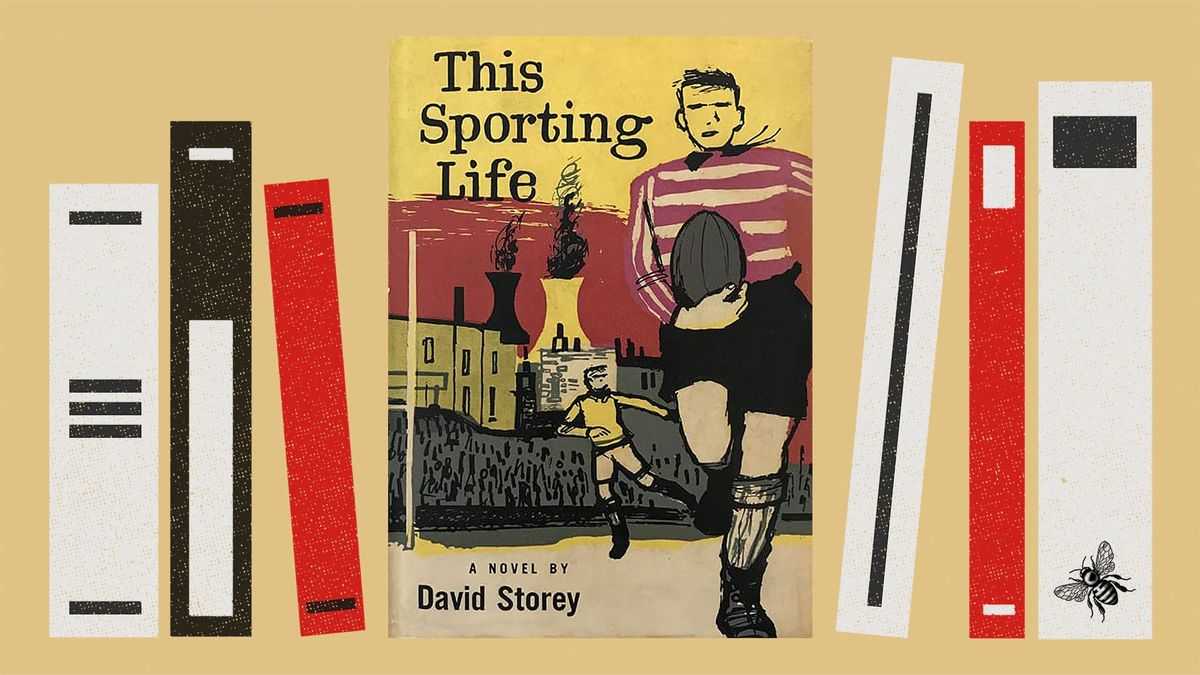
In Rugby League, which in the UK is mostly played in former industrial towns and cities in northern England, and associated with the working class, players were paid, unlike their Rugby Union counterparts. In Storey’s own words: ‘I went for a trial and played two trial games and they signed me on for what seemed a lot of money: £1,200, for which I got £400. I would get the second £400 when I was 21. The contract was until I was 32.’ In today’s money, these lump sums are equivalent to nearly £4,000 each. Storey later reflected that, ‘rugby league in those days was seen as a species of prostitution.’ Allegedly, when he signed professionally, his former deputy headteacher wrote to say that he had let the entire school down.
Storey played as the Leeds A side’s half-back for five years during weekends on a weekly wage of £6, and spent his signing-on bonus on fees for the Slade School of Fine Art, which he attended during the week. He found time to write on the commuting train. Upon graduating with his three-year diploma in 1956, Storey bought out the remainder of his contract with Leeds, feeling dislocated from both halves of his life. (After a disastrous formal event organised by Storey as president of the Slade – to which Lucian Freud brought his dog as a plus-one – he had been asked not to come back to complete his fourth year.) He worked as a tent contractor in Wakefield. He then found work as a schoolteacher while living above a sweetshop in King’s Cross. He married his childhood sweetheart Barbara Rudd Hamilton in 1956, with whom he had four children.
After multiple rejections, Storey’s first novel This Sporting Life was published in 1960 by Longmans (since acquired by Pearson). It received critical acclaim, winning the Macmillan Fiction Award and making an immediate mark on 1960s British literature. Within three years it had been adapted into an Oscar-nominated film starring Richard Harris and Rachel Roberts. On its release in 1963 the film, the Guardian’s Peter Bradshaw has written, ‘provided one of the great energising shocks of the 1960s, a blast of energy, smashing at the dullness, the complacency and hypocrisy of class-ridden Britain.’ Storey followed This Sporting Life with Flight into Camden (1961), winner of the John Llewellyn Rhys Prize; Radcliffe (1963), winner of the Somerset Maugham Award; Pasmore (1972), winner of the Geoffrey Faber Memorial Prize; A Temporary Life and Edward (1973); Saville (1976), winner of the Booker Prize; A Prodigal Child (1981); Present Times (1984); The Phoenix (1993); A Serious Man (1998); A Star in the West (1999); As It Happened (2002); and Thin-Ice Skater (2004).
Storey was also known – perhaps better known, in fact – for his plays, often co-produced with Lindsay Anderson. His first – To Die With the Philistines – was roundly rejected, until a young director rediscovered it six years later and reworked it as The Restoration of Arnold Middleton (1967), for which Storey shared the Evening Standard Award for Most Promising Playwright with Tom Stoppard. Later plays at the Royal Court Theatre included The Contractor (1969), Home (1970), and The Changing Room (1972), which all won the New York Critics Best Play of the Year Award; In Celebration (1969), adapted for the screen in 1974; The Farm (1973); Life Class (1975); Mother’s Day (1976); and Sisters (1978). Storey’s plays moved to the Royal National Theatre with Early Days (1980), The March on Russia (1989) and Stages (1992).
His career in the theatre was not uncontroversial: during the 1970s, Anderson denied free tickets to a reviewer – Hilary Spurling – who was only reluctantly re-added to the press list after the Arts Council intervened. Similarly, following a series of poor reviews of Mother’s Day in 1976, Storey punched critic Michael Billington with three impressive blows while shouting, ‘Idiot!’ on impact. However, despite his career as a rugby player, and a quality that could be called bluffness, Storey struggled with anxiety and depression throughout his life. This is discussed openly in the successful memoir A Stinging Delight, published posthumously in 2021 after his death from Parkinson’s disease and dementia on 27 March 2017.
This Sporting Life, class and social realism
This Sporting Life was published in 1960. It tells the story of Arthur Machin, a working-class Yorkshire rugby league player whose rise to professional success is dogged by emotional and social struggle. After signing with a local team, Machin lodges with his widowed landlady, Mrs Hammond, and develops an intense, often destructive attachment to her. Burdened by grief and wary of his aggression, Mrs Hammond ultimately rejects his advances; meanwhile Machin attempts to assert control over his career, relationships and identity within a rigidly stratified working-class environment. Storey contrasts the physical brutality and commercialisation of sport with Machin’s inner vulnerability, depicting a man unable to articulate his emotions except through force and persistence.
In its first edition, the jacket featured a stern line illustration of a rugby player charging towards the viewer, with factories clearly visible in the background. It ran with a subtitle – A Novel – perhaps used to distinguish it from memoir, given Storey’s former rugby career, and to lend it a kind of literary legitimacy in the eyes of the publishing establishment. This interpretation is reinforced by the front flap copy, which reassured the reader that ‘This book is recommended by the Book Society.’ The retail price of 16 shillings (roughly £23 today) is also clearly marked. It is striking to compare the 1960 edition with the most recent reissue as part of the Vintage Classics series, published in 2018. This remodelled design emphasises the ‘split psychology’ motif of the novel, and gone are all signs of northern industrial life. Instead, traces of the love story are made explicit through the highly gendered visuals.
Storey’s connection to his working-class roots remained a point of contention throughout his life, which found its way out in various guises through his work. In three separate interviews with theartsdesk’s Jasper Rees, Storey spoke openly about his dislocated life of ‘double exile’. As an educated man whose academic and creative pursuits kept him out of the coal mine where his father had spent his life, Storey voiced a sense of guilt connected to his decision to sign with Leeds. ‘I felt I was an outsider, I was there under false premises […] I wanted to be an artist, a writer and a painter, and I really went to art school in order to have time to write,’ he explained. ‘My father wouldn’t support me there so I played rugby league in order to go to art school in order to learn to write. There’s a kind of duplicity involved there. [My father] approved of [the rugby] because I was connected with the real world at last.’
The idea of real and unreal worlds resurfaced often in his writing and conversation. ‘There are two Wakefields,’ he told Rees. ‘There’s an imaginary Wakefield and there’s a real Wakefield which, horrifically, I see when I get there. And the two are increasingly separated. When I go back, although I prepare myself, I know it’s going to be a shock, but what’s there now has this rather frightening resemblance to what used to be there but isn’t what it was […] I don’t feel I belong anywhere particularly.’ His 1969 play In Celebration – about Nottinghamshire brothers returning home for their parents’ fortieth wedding anniversary – epitomised the alienation of the postwar generation’s access to educative and economic opportunities which were denied to their parents, creating the uneasy social mobility which informs This Sporting Life.
A contemporary Guardian review from critic and rugby league pundit Geoffrey Moorhouse pointed out that ‘An interest in rugby league is by no means necessary to appreciate this story, any more than a fascination with whaling has ever been vital to an enjoyment of Moby Dick.’ Other critics saw that there was more to this novel than the sport or recognisable kitchen-sink tropes, and the 1963 film accelerated the classification of Storey’s novel as a classic text, spawning significant coverage and homages even into the present day. In recent years, features on This Sporting Life have been published by the Guardian, the Paris Review, and the New York Times (which also favourably reviewed Lindsay Anderson’s film adaptation in 1963). New York Times critic Clive Barnes described Storey’s work as ‘gripping and unusual’ in 1973, in a review of his stage play The Changing Room, which encounters similar thematic ground to This Sporting Life. In his review, Barnes summarises rugby league for his transatlantic audience:
‘A semi-professional game that is played only in the coal-mining areas of the north of England, and is not to be confused with the better-known Rugby Union amateur game, although there is not too much difference in the rules. There is, however, the men who play the game. This is one of the roughest games in the world, partly because the players go out onto the field quite unpadded. The competitive nature of the game also makes it tough and bloody. The players are working-class, a lot of them miners during the week. They will use weekend rugby to add to their meagre earnings.’
Working-class fiction, Kitchen Sink Realism and Angry Young Men
The 1950s and 1960s saw a boom in fiction, drama and film from the industrial north, which was in some ways an offshoot of the Angry Young Men school. This wave of so-called ‘kitchen sink realism’ was authored by a group of northern working-class creatives (including the visionary Shelagh Delaney), though the term was derived from the “Kitchen Sink School”, which originated in 1954 in the visual arts courtesy of critic David Sylvester, who coined the name to describe the work of the Beaux Arts Quartet.
The genre has its roots in the postwar political landscape, often foregrounding working-class antiheroes who strive for the ideals of socialism and react against the ephemeral qualities of romanticism. John Osborne’s 1956 Look Back in Anger is considered the theatrical trailblazer (although the 1947 film adaptation of the Arthur La Bern novel, It Always Rains on Sunday, may be thought of as an early precursor). It was the Royal Court’s press officer George Fearon, for Osborne’s play, who created the term ‘Angry Young Men’ as part of his promotional work, and it stuck. As the fifties turned into the sixties, it became associated with kitchen sink realism, even though the two concepts were originally quite separate.
Kitchen sink drama was especially popular on screens, including such films as Saturday Night and Sunday Morning (1960), A Taste of Honey (1961), A Kind of Loving (1962), Alfie (1966), and Spring and Port Wine (1969). However, despite the success of US-based films such as A Tree Grows in Brooklyn (1945), kitchen sink realism seems to have been a distinctly British scene. The movement was in its heyday in Britain at the time of This Sporting Life’s publication. Other bestselling novels of the time spoke to similar interests in true-to-life grit and scenarios reflective of the new decade’s changing tastes and attitudes, including Muriel Spark’s The Ballad of Peckham Rye, Border Country by Raymond Williams, Harper Lee’s To Kill a Mockingbird, Advise and Consent by Alan Drury, and Hawaii by James Michener.
Storey sat both inside and outside the movement. He did not consider his writing to be much influenced by this strand of art and thought; rather, he cited a ‘Damascene moment’ during a school French lesson, while his teacher read from a Verlaine poem: ‘I had this vision that we were all on a railway line, that we were all going to be schoolteachers: you could see marriage, a house, a car, a salary, a pension … and right at the end of the line was the one word, death. It came across in a matter of moments and it seemed extraordinarily clear. I just decided that I would do something with my life that was different to all that had been expected […] The volition to write was much more personal than anything that came from being in a movement.’
His Telegraph obituary described Storey as a product of ‘the northern working-class drama explosion of the early 1960s’, adding that he ‘never had the visibility of contemporaries such as Alan Sillitoe and John Braine’, and is chiefly remembered as a dramatist. This Sporting Life was rejected for publication multiple times, this rejection providing the push that sent him into playwriting. ‘I really belonged to the previous generation,’ Storey once said. ‘[John] Osborne, [Arnold] Wesker, [John] Arden. Their plays were not thought to be worth doing [at the Royal Court] any more, or they were not writing plays with the same engagement with society. After I arrived it coincided with what was called the second wave, which I think was comprised of me, Edward Bond and Christopher Hampton primarily.’ Storey perceived himself as joining the kitchen sink genre, rather than helping to start it.
The second wave had largely run its course by the mid-seventies. ‘I think I’ve been very fortunate. I couldn’t get my work accepted. This Sporting Life was rejected for four years, otherwise it would have come out at the time of Look Back in Anger and Room at the Top. It was rejected by 15 publishers over those four years. It was only accepted by a publisher who covered his face in his hands and said, “Oh God, I hope I’m doing the right thing.”‘
*
To understand quite why this generation’s work resonated to the extent that it did, it is essential to grasp an understanding of the postwar British creative industries landscape. During the war, British publishing was subject to major restrictions, including a shortage of physical paper as well as information censorship. A key instruction from the government was that books published during this period should be both morale-boosting and didactic – for example, disseminating advice on animal rearing for food and allotment maintenance. By the 1960s, there was an appetite for cultural forms which more accurately depicted the lived reality of a majority of people in Britain at the time, fostering an environment in which kitchen sink fiction flourished. For instance, the success of Lynne Reid Banks’s 1962 The L-Shaped Room, which arguably speaks to the genre’s core themes, was widely attributed to riding the wave of changes in social attitudes. (Banks is also alleged to have served as real-life character inspiration for her literary nemesis Osborne’s Look Back in Anger.) This Sporting Life’s exploration of sexuality, contraception, and psychological struggle similarly dovetailed with many of these attitudes, suggesting that these works may have originated in response to – as opposed to kindling – such cultural moments.
The working-class existentialism which influenced kitchen sink coincided with the creation of Arts Council England in 1946, during a much-lauded ‘era of increased opportunity for all’. Advocated by John Maynard Keynes, the council was set up by royal charter as the Committee for Encouragement of Music and the Arts in 1940 and was authorised for government spending by 1948. Despite this sense of ‘increased opportunity’, the forties and fifties were immensely challenging times economically, especially as the lifeline that was the coal industry in the north and in Wales increasingly declined.
Keynes himself, although raised in an upper-middle-class household, was the son of social reformer Florence Ada Keynes, an influence perhaps visible in his famous 1945 essay setting out his vision for the Arts Council:
‘The task of an official body is not to teach or to censor, but to give courage, confidence and opportunity. Artists depend on the world they live in and the spirit of the age. There is no reason to suppose that less native genius is born into the world in the ages empty of achievement than in those brief periods when nearly all we most value has been brought to birth. New work will spring up more abundantly in unexpected quarters and in unforeseen shapes when there is a universal opportunity for contact with traditional and contemporary arts in their noblest forms.’
This increasingly monetised cultural landscape was marked by the advent of popular icons from the north, including the Beatles, Coronation Street and artists like David Hockney. The constellation of kitchen sink names rapidly became mainstream, before being overtaken by the craze for science fiction. Indeed, these divergent genres may be thought of in explicitly political terms: after the false buoyancy of second world war-era fiction, the kitchen sink aesthetic to which Storey and This Sporting Life belonged symbolised a desire for true-to-life representation, which evolved into a utopian desire for change and recalibration. We might even say that the 1950s and 60s scrubbed away the glossy façade of wartime propaganda to reveal the grime and grit beneath, while the 1970s gave it a new, optimistic lick of paint.
However, it is also important to think through questions of presentism here: were the fifties perceived to be so bleak at the time? This was also a period characterised by the end of rationing, the return of economic growth, the beginning of TV advertising, the advent of the teenager, the popularisation of hire-purchase and a common belief that growing affluence was eroding class identity. Director Ken Loach is quoted as saying indignantly: ‘The Fifties weren’t bleak and depressing. It was great. We had just won the war!’
Sport and Rugby League literature
The 1960s, then, proved to be a watershed moment in many ways, from arts and culture to social attitudes to sports. In particular, the move from modernist values into postmodernist quests for personal autonomy and social liberation became a turning point for the transformation of class relations in rugby and cricket particularly. During the 1950s, these were two sports characterised by the presence of amateur players – often wealthy “enthusiasts” who were skilled but unpaid members of the team, expected to finance themselves. Increasingly, however, these amateurs were displaced by a growing fleet of professional players.
By the end of the fifties, only six sports counted many of their players as formal professionals: cycling (7000); football (4000); boxing (1700); golf (1500); cricket (300) and horse racing (270). In cricket specifically, amateur players were addressed as “Mr” or “Sir”, while professionals were addressed only by their surnames, indicating the maintenance of class divides within these spaces. Cricket was also known for veiled professionalism, whereby amateur players could claim expenses equal to the payments made to professionals without paying tax on them. The amateur player was eventually phased out after 1962, when alternative leisure activities such as holidays abroad and car ownership became accessible to working-class people, diminishing cricket’s appeal as a weekend pastime.
Around the same time, as Britain began to lose its grip on its imperial monopoly and its international prestige came under scrutiny, there was an increased desire for excellence in sports, of which the practice of amateurism fell woefully short. As a result, Harold Wilson appointed the first minister for sport in 1964 and directed government funding into sports through the Sports Council. This opened the doorway for underrepresented competitors who could not have previously afforded to participate.
The history of rugby union is intricately entwined with that of both professionalisation in sport and that of football (and the forms of writing which have emerged from both). Rugby as a sport developed out of precursors to modern football, and in particular one ball game which was described as taking place in a medieval London street. This particular game was played around Shrovetide and created a community across the feudal hierarchy, until it was banned by King Edward II in 1314. Edward and his nobility feared that commoners would favour it over practising their archery, then a compulsory activity for all able-bodied men and boys outside the nobility, which was vital for maintaining England’s military sovereignty. Nonetheless, across time, football in the UK has broadly been characterised as a working-class tradition in a way distinct from rugby or cricket.
The presence of rugby and cricket on many fee-paying schools’ sports syllabuses may have contributed to this notion, as did the prevalence of amateur players prior to the 1960s, which necessarily excluded working-class players. The Rugby League was formed in 1895 when 21 clubs in the north of England rejected the English Rugby Union to enable them to pay their players, putting an end to the amateurism which was still practised elsewhere in the country. In 1948, the very first rugby league match was televised when Wigan beat Bradford in the Wembley Challenge Cup final; by 1965, rugby league had staged a World Cup tournament, attracted almost 70 million paying customers to its pitches, and then BBC controller David Attenborough scheduled Tuesday televised games via the BBC2 Floodlit Trophy. The midweek evening slot was chosen because of its potential to reach a wider audience of working-class individuals, who were most likely to be home or within reach of a TV elsewhere (at pubs, for example) at this time.
During this period, British television was beginning to diverge in terms of audience. Broadly, there was sport for men, soaps for women, and cartoons for children, with complementary advertising models applied to each. It is worth noting that these soaps were influenced by the kitchen sink school, often foregrounding the lives of working-class people.
Televised sport has been linked to certain behavioural transformations within communities for whom watching or engaging in sport is an important social ritual. In particular, throughout the second half of the 20th century, professionalised sports became globally respected as well as denigrated for “showy” displays of wealth, as in the case of the controversial footballer George Best. Globally, game broadcasts also changed the face of sports journalism and writing, as commentators and pundits moved away from simply summarising the state of play and towards detailed, colourful narratives which searched for the story behind the story.
Just as the hyperbolic emotional scene of sixties soaps modelled values linked to contemporaneous beliefs around femininity within the domestic sphere, televised sport may have provided men – and especially working-class men – with an arena in which to vocalise the emotional climates of their lives. In his essay Emotional Grounds: Stories of Football, Memories, and Emotions, Professor Alan Bairner observes that ‘Men were uncomfortable with expressing their emotions, football and its spaces providing some of the few available loci for emotional outbursts’, with powerful implications for the development of a masculine, working-class nostalgia. There is a romanticism here which is at the heart of This Sporting Life and other seminal sports fictions, including The Damned Utd (2006), Rabbit, Run (1960), and The Natural (1952).
This Sporting Life: film vs novel
After This Sporting Life won the Macmillan Award for Fiction, the film industry sat up and took notice: Storey was wined and dined by moguls Stanley Baker, Tony Richardson and Joseph Losey in turn. The rights were eventually sold for £10,000 (equivalent to roughly £250,000 today) to British production company Rank. This Sporting Life provided the directorial feature debut of Lindsay Anderson; Storey himself wrote the screenplay, after being introduced to Anderson by producer Karel Reisz. The two quickly became firm friends.
The film was beset by difficulties on the road to distribution. Albert Finney turned down the part of Arthur (renamed ‘Frank’) Machin. Rachel Roberts – ultimately cast as Margaret – also turned down the role twice. Anderson feared he was not up to the task of directing. Storey and Anderson quarrelled over the script, and were reconciled only by its star, Richard Harris, who advocated for the film’s subjective point-of-view form over a series of flashbacks. Indeed, during filming at the ground of Wakefield Trinity Rugby League Club, local players stood in for extras and were, it is said, looking forward to roughing up the actor during action scenes. However, according to Storey’s Times obituary, ‘when Harris appeared, they were standing in a group, hands on hips, sullen. Harris ran at them full pelt. They only realised he was not going to stop before it was too late. Harris was instantly simpatico’.
Anderson later wrote that it was Harris himself who requested Arthur Machin’s name be changed to Frank for the purposes of the film. As Anderson wrote, ‘Frank Machin was immediately striking, with an ambiguity of nature, half overbearing, half acutely sensitive, that fascinated me without being fully aware that I understood him. The same was true of his tortured, impossible affair with the woman in the story.’ Anderson was widely believed to have been in love with Harris, although this fact was not made public until after his death in 1994. Their relationship during filming was remembered by Cliff Goodwin in his biography of Harris: ‘On set, Harris would suddenly turn on Anderson. “Stop smiling,” he would say through clenched teeth. “I’ll smile if I wish to.” “You’ll smile when I tell you to,” Harris ordered, delivering a hefty punch to Anderson’s upper arm. The director admitted there was a “strange sadomasochistic element to our relationship.”‘
This Sporting Life is a film which remains dramatically ambivalent about its representation of masculinity, class, and professionalisation. Beyond its homoerotic overtones, Storey’s recollection of his old schoolmaster’s characterisation of rugby league as ‘prostitution’ is also vividly brought into focus in the film, such as the scene during which Weaver, the team owner, drives Frank home and places a hand on his leg, suggesting the expectation of sexual favours in exchange for a place on the team. In his revisit of the classic film, critic Joe Jackson highlights the feminising pancake makeup which Harris wears throughout: ‘There are so many lingering, languorous body shots and close-ups of Richard in This Sporting Life that the movie could have been called From Lindsay With Love’.
In terms of financials, Storey spoke candidly in several interviews about the economic realities of writing. This Sporting Life was not a commercial success; Storey earned more from the film adaptation and from his plays. Not until This Sporting Life won the Macmillan Award for Fiction in the US did Storey see much return on his most famous novel; with the prize money, he allegedly bought himself a white Jaguar, which was the only place in which his baby daughter would fall asleep. On multiple occasions, however, he turned down Hollywood filmmakers to prioritise art over money despite having four children to support, as well as his parents. ‘It was very difficult to make a living, certainly just as a novelist.’ By contrast, supplementing his income with stage and screenplays allowed Storey to comfortably support two households.
In part it was Storey’s association with Anderson which would prove the most lucrative of his life. More specifically, This Sporting Life has been praised for its furthering of the British New Wave of film in its use of landscape, class critique, and auteurism, which inspired a host of subsequent British sports films such as Playing Away (1987), The Damned United (2009), Believe (2013), and Jawbone (2017). In these films, and in the hearts of several new generations who have discovered the film and novel since their releases, the influence of This Sporting Life endures.
All donations go towards supporting the Bee’s mission to nurture, publish promote and pay for the best new working-class writing.




Comments